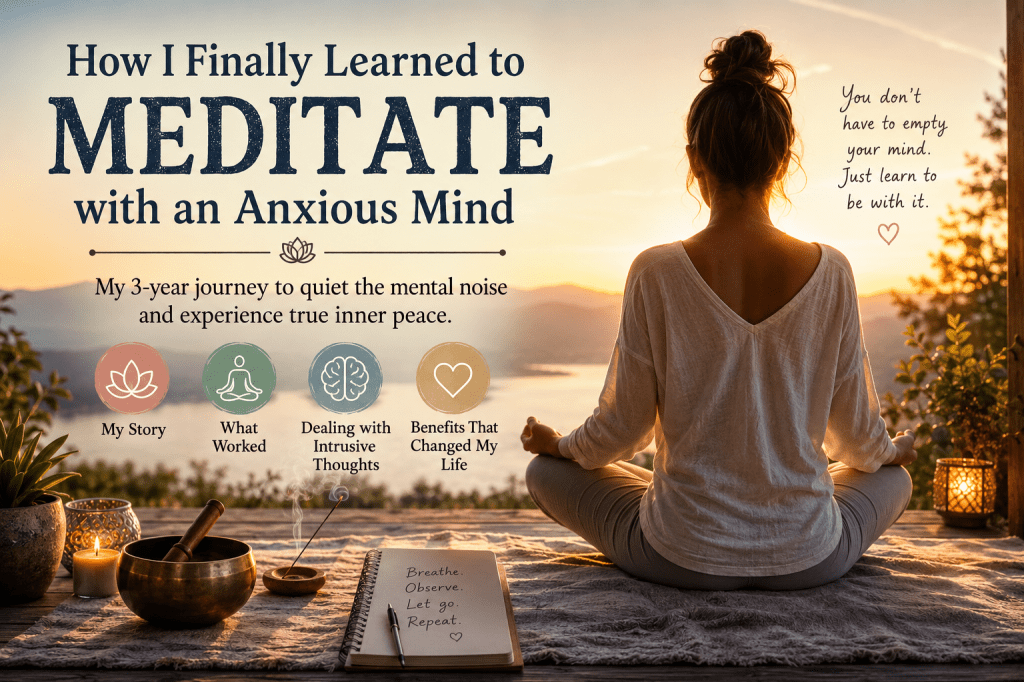
I was 31 years old when I decided to learn how to meditate. I was inspired by the short guided meditations at my yoga classes. I remember they were simple 5–10-minute breathing exercises while sitting on a yoga mat. A woman would guide our attention through the main parts of our bodies, encouraging us to consciously release stress and fill ourselves with what she called “the blue light of calm.”
I love yoga, but those ten minutes were always my favorite part.
So, I started trying to meditate at home. However, I quickly realized that the more I tried, the more difficult it became to free my mind from worries and random thoughts. As soon as I sat on the mat, all kinds of silly thoughts would take over my head: I need to add tomatoes to the shopping list. Those song lyrics are so stupid. I’m so tired. I wish I could go on vacation.
My thoughts were so random that they could jump from one topic to something completely unrelated in a split second.
Without the guidance of that familiar voice, I couldn’t find the same feeling of relief and renewal that I experienced in my yoga class.
So, I decided to do a little research. The research became a quest, and the quest became a real-life purpose.
I bought books, listened to podcasts, watched videos, and started talking to people whom I thought could help me learn how to quiet my mind and reach a deeper state of meditation. But none of it worked the way I wanted it to.
I met many fascinating people, including an Indian swami. I visited his ashram, talked with him for hours, and even met his pet cow, who happened to adore strawberries. I met a therapist who took me under her wing and taught me many relaxation techniques she believed would help me. I met a wonderful priest who showed me how to combine psychological approaches with my spiritual desire to find peace.
I met so many kind and helpful people, and I will always keep them close to my heart.
Even though all of their advice helped illuminate the path toward my goal, my anxious brain seemed determined to sabotage me. After nearly three years of trying everything I had learned, I was able to relax, but I still couldn’t completely quiet my mind or reach the profound meditative state that yogis and spiritual teachers often described.
Then one day, I met a Buddhist practitioner who provided the final piece of the puzzle.
I combined everything I had learned throughout my journey, and the result was the deepest meditative experience I had ever known. Even now, I struggle to find the words to describe how profoundly that first experience changed my understanding of the power of the human mind.
Today, I want to share what helped me, from the beginning of my journey to the breakthrough that changed everything.
The Place Is Important
If your backyard isn’t fenced, is close to a busy street, or there are children playing nearby, try to find a quiet place free from interruptions.
Create an atmosphere that helps you relax. You can play solfeggio frequencies, singing bowls, Sufi music, or any music that calms you down. You may also want to light a candle. The soft glow helps many people relax, and the flame can become a focal point for your breathing practice.
Aromatherapy can also enhance the experience. You can use scented candles, incense, aromatic wax melts, an essential oil diffuser, or even fresh flowers. I’ve used all of these at different times to create a peaceful environment and help my anxious mind settle when meditating indoors.
The Two Positions That Worked for Me
This part is different for everyone.
If you’re a beginner, sitting in the lotus position for more than ten minutes can feel like playing meditation on expert mode. Let me share a secret: it doesn’t have to be done in the lotus position, and you don’t need a complicated mudra with your hands.
One of the positions that worked best for me was simply lying down on my mat in a comfortable supine position. Place your palms facing upward in a receptive posture and combine this position with PMR (Progressive Muscle Relaxation) to release physical tension, stress, and anxiety. Pair each muscle release with a simple breathing technique and start there.
If you haven’t already, I highly recommend checking out our PMR guide: Progressive Muscle Relaxation (PMR): A Simple Way to Release Stress and Relax Your Body
If lying down isn’t for you, you can also sit on your mat in any position that allows you to remain comfortable and still for at least five minutes. For me, sitting with my legs extended worked surprisingly well.
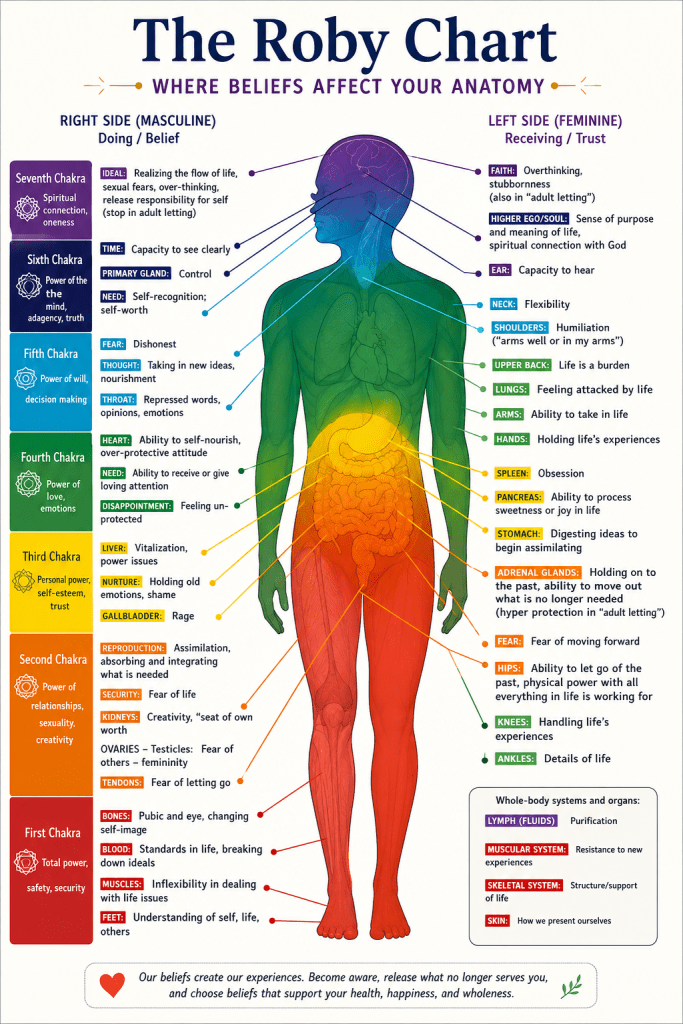
Find a wall to support your back and combine your favorite breathing exercise with visualization. I like using the chakra system as a guide. Starting from the bottom of the body and moving upward, focus on each chakra and visualize its corresponding area glowing with a bright color.
For example, begin with the root chakra. Visualize the base of your spine and your legs surrounded by a bright red light. Slowly inhale, hold your breath for five to ten seconds, and then exhale slowly while maintaining the visualization. Continue this process through all seven chakras.
If you’re not familiar with the chakra system, feel free to download the Roby chart or create your own visualization method. The important thing is to find something that resonates with your beliefs and gives your mind a meaningful focus while you practice your breathing.
Extra Tip
As soon as you sit or lie down, consciously relax your body, especially areas that tend to hold tension, such as your shoulders and neck. Let your belly soften and avoid tensing any muscles unnecessarily.
The Thoughts
Every mind is its own universe, and each one works differently. What works for me may not work for everyone else.
The purpose of this post is simply to share what worked for me. In a future post, I’ll share my top three techniques for managing intrusive thoughts and finding more mental peace.
The approach that helped me most was allowing my thoughts and emotions to move freely while observing them as a neutral witness. Instead of getting caught up in the endless cycle of I should, I must, or I shouldn’t, I learned to simply watch.
Let your thoughts come and go. Observe them. Release the need to react to every idea, emotion, or memory. Shift from an impulsive mindset into a detached and observant state of awareness.
This lesson came from my Buddhist friend, who introduced me to the practice of “bare attention.” For that lesson, I send him gratitude and a warm hug of light.
Once I incorporated this practice into my meditation sessions, everything began to change. Instead of fighting my thoughts, I let them exist. Rather than becoming absorbed by them, I focused on my role as the observer.
Over time, I noticed that when thoughts were no longer being resisted, they began to lose their power. They flowed naturally from one topic to another until, eventually, moments of stillness appeared on their own.
You can also bring this practice into your daily life. It can help you better understand your worries, plans, memories, and recurring thoughts while cultivating a nonjudgmental awareness that supports conscious self-regulation.
Over time, it can help develop acceptance, trust, openness, patience, and a deeper understanding of yourself.
The Benefits of Meditation
The benefits of meditation for both mental and physical health have been well documented for many years. If you’re interested in the research, I encourage you to explore studies such as Dr. Jamil Guatlapalli’s Meditation and Its Mental and Physical Health Benefits (2023).
Research has shown that meditation can support people dealing with a variety of challenges, including PTSD, social anxiety, stress, concentration difficulties, and even aspects of immune function and inflammation.
For me, meditation became much more than a wellness practice.
It helped me navigate some of the darkest moments of my life, and for that reason, I will always recommend it to anyone willing to give it a sincere try.
Making Peace with Your Mind
If there’s one thing I learned from this journey, it’s that meditation isn’t about forcing your mind to become empty. For many of us, the real breakthrough comes when we stop fighting our thoughts and learn how to sit peacefully beside them.
Your path may look different from mine. You may discover techniques that resonate more deeply with you, and that’s perfectly okay. Meditation is a personal journey, and there is no single “correct” way to experience it.
Thank you for taking the time to read this story and be part of this community. If this post resonated with you, I’d love to hear about your own experiences with meditation.
Have you struggled with intrusive thoughts? Have you found a technique that works especially well for you? Please share your thoughts in the comments below. Your experiences may help someone else on their own journey.
And if you enjoyed this post, consider giving it a like and sharing it with someone who might benefit from it. Your support helps this blog continue to grow and allows me to keep sharing the lessons I’ve learned along the way.
 With A Grateful Heart by Chris Gil
Leave a comment