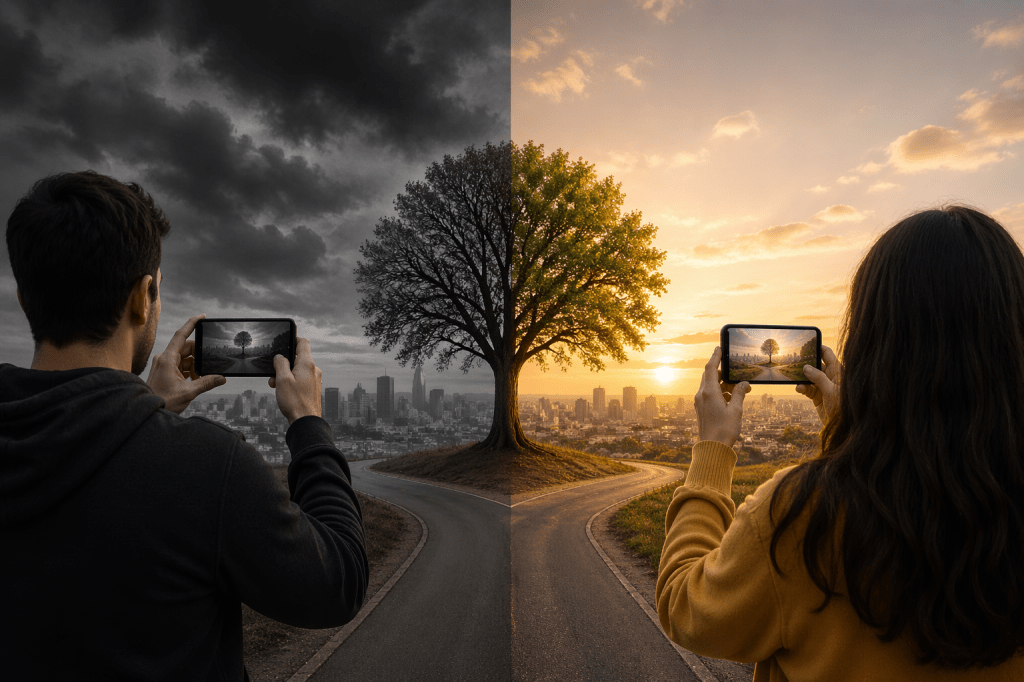
We’re All Reading the Same News… But Seeing Different Realities
What if the biggest problem with news today isn’t that we don’t have enough information, but that we all think we already understand it?
Just open any social media app for a few minutes and you’ll see it; breaking news, strong opinions, and people arguing in the comments. The same event shows up in different ways, and each version seems sure it’s the truth.
For example, I remember seeing a situation shared online where a police encounter led to someone’s death. Videos from different angles spread quickly, but people still disagreed on what really happened. Depending on the source, the story felt completely different. To me, that shows how confusing truth can become in a post-truth world.
A Pew Research article by Luxuan Wang and Naomi Forman-Katz explains why this happens. About half of U.S. adults get at least some of their news from social media. It makes sense, it’s fast, easy, and always there. News comes to you along with real-time debates, reactions, and opinions that help us validate our own views.
But that convenience has a downside. Around 40% of people say misinformation is a major problem, and that concern is growing (Wang & Forman-Katz, 2024). People also point to bias, low-quality content, and censorship. Still, social media remains one of the main ways people stay informed.
That’s the contradiction: even without fully trusting what they see, people continue forming opinions based on it.
The idea of a “post-truth world,” explained by Manias-Monroe, helps make sense of this. It’s a reality where feelings and beliefs often matter more than facts. The Pew article shows how this plays out in everyday life; information isn’t just about what’s true, but how it feels, how it spreads, and who shares it.
This is something I’ve noticed personally too. The same story can look completely different depending on the source. A headline, a video, or even a caption can shape how people understand what’s happening.
That’s why I try to look at multiple perspectives instead of relying on just one. When something makes me form a strong opinion, I ask myself:
- What is this person’s intention in presenting the facts this way?
- What are their political views?
- If this were presented differently, would my opinion change?
- What perspective might be missing?
- Are my emotions influencing my thinking?
These questions don’t solve everything, but they help me pause and think more clearly.
At the end of the day, a “post-truth world” isn’t just about fake news, it’s about how truth can get blurry when information is constant, emotional, and personal. Maybe the real challenge isn’t finding the truth, but holding on to it while so many voices try to shape it first.
I’d love to hear your thoughts, does social media help you understand the world better, or does it make things more confusing?
Works Cited
Manias-Monroe. PHI 1600: The Moral Compass. 2025.
Wang, Luxuan, and Naomi Forman-Katz. “Many Americans Find Value in Getting News on Social Media, but Concerns About Inaccuracy Have Risen.” Pew Research Center, 7 Feb. 2024.
 With A Grateful Heart by Chris Gil
Leave a comment