

How including diverse artists add to the conversation about the history of art and what learning about these diverse artists means to me on a personal level?
Learning about diverse artists really opens up the story of art beyond what we usually see in textbooks. It gives space to voices, cultures, and experiences that have often been left out. Artists like Amaya Salazar and Erich Caparas show how identity and heritage can shape creativity in powerful ways. Through their work, both artists highlight the power, relevance, and versatility of the female figure in today’s world; celebrating women not just as subjects, but as symbols of strength, emotion, and resilience.
Personally, exploring their stories made me appreciate how diversity keeps art alive, meaningful, and connected to real people. Their work reminds me that art isn’t just about style or technique; it’s about expressing who we are and where we come from. Interestingly enough, exploring their stories made me appreciate how diversity keeps art alive, meaningful, and connected to real people.
If you’ve ever felt that a painting or a photograph could breathe, these two works might just prove it. Both artists, though different in medium and style, capture the essence of womanhood, light, and identity in ways that feel deeply human and spiritual.
Let’s dig in on the two pieces I chose for this post today.
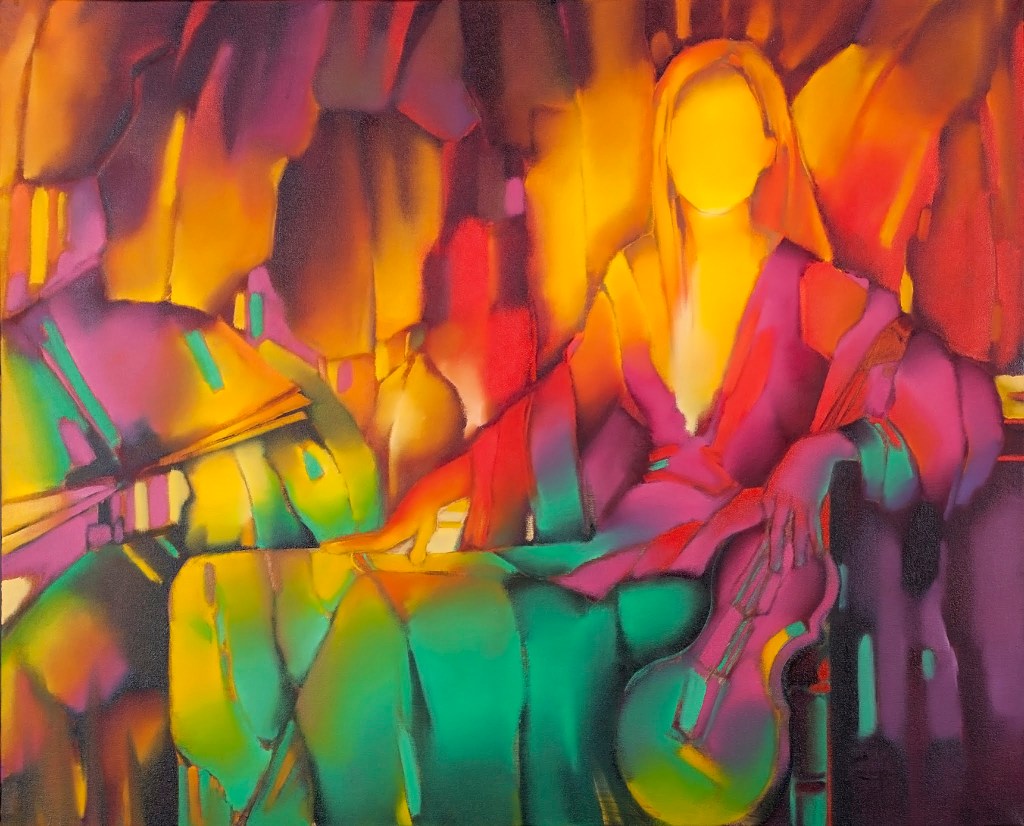
Salazar’s Sinfonía Cromática radiates warmth and mystery. The faceless female figure, surrounded by luminous Caribbean greens and yellows, feels both personal and universal; like a reflection of every woman’s strength and calm. The lighting seems to come from within her, and the curving lines of her body blend harmoniously with the banana leaves around her.
Amaya Salazar is a celebrated painter and sculptor, born in Santo Domingo, Dominican Republic. She studied art in Madrid, Spain and at the School of Fine Arts, in Boston, MA. (Alchetron). Her work is primarily inspired by the female form and mother- and-child imagery. She’s known for her luminous, vibrant, and deeply feminine visual language. Her technique blends Caribbean warmth and tropical flora with universal themes of introspection, resilience, and faceless figures representing the diverse heritage of the Dominicans and Caribbean people. The absence of facial features in her work doesn’t erase identity; it expands it, symbolizing unity, equality, and shared identity among Dominicans, regardless of race, skin color, or background,(Latin Art Museum). In short, the figures have no face because they represent everyone. Amaya’s artwork is included in private and institutional collections worldwide,(U.S. Art in Embassies) and has been exhibited widely across the Caribbean, USA, Europe, and Latin America, establishing her as a symbol of Dominican cultural pride and feminine strength.
She’s undoubtedly my favorite contemporary artist because she represents the idea that beauty and identity transcend physical appearance, illuminated through her masterful use of color and light.

Caparas’s portrait of a Black woman painted with gold and pearls is the kind of image that stops you in your tracks. Her closed eyes and upward gaze radiate inner peace and strength. The contrast between the gold tones and deep shadows gives the portrait a sculptural power; almost as if the subject is carved from light itself. Caparas masterfully blends traditional portrait lighting with digital precision, creating an image that feels sacred, almost timeless.
“A dance between light and pixels where technology becomes invisible and emotion takes the lead.” – Erich Caparas, Official Portfolio
In my opinion, both artists highlight the power, relevance, and versatility of the feminine figure in today’s world. Salazar paints women as symbols of shared identity, while Caparas photographs them as icons of spiritual beauty. Together, they remind me that art is not just about how something looks; it’s about how it feels and what it reveals about us.
These works make me wonder: how do light, texture, and presence shape the way we connect to an image? And what do you see when you look at portrayals of women in contemporary art; perhaps strength, mystery, peace, or something else entirely?
I’d love to hear your thoughts!
Drop a comment below and tell me.
 With A Grateful Heart by Chris Gil
Leave a comment